

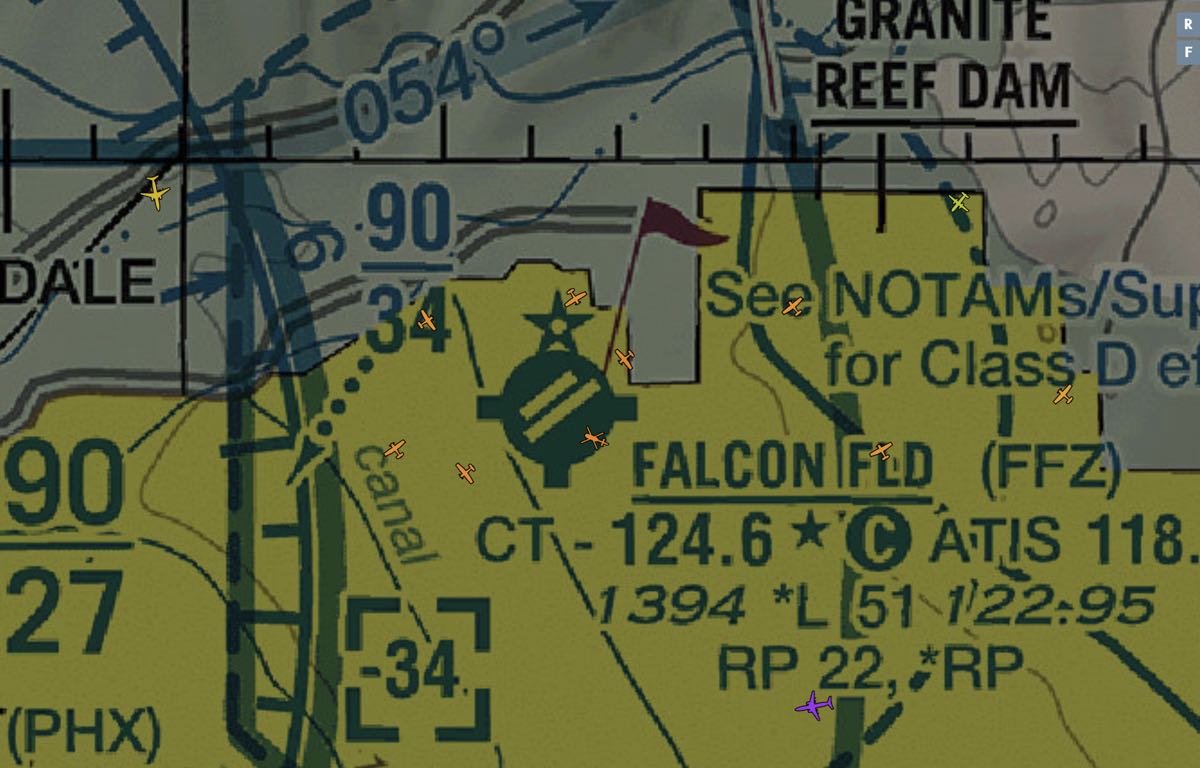
The FAA has stepped into the fight against landing fees at Falcon Field Airport (KFFZ) in Mesa, Arizona.
As the city prepares to implement the controversial landing fees on July 30, 2026, it received a letter from Michael Helvey, the FAA’s Director of Office of Airport Compliance and Management Analysis, telling city officials that the agency recommends the city “delay implementation until the FAA review of the matter is completed.”
The letter notes that “at least two” informal complaints have been filed by airport users, which requires the FAA to investigate the allegations “based on arguments of the complaints, the city’s response, existing facts and documentation and, if needed, additional data and information from the complainant or the city.”
Two flight schools at the airport, CAE Aviation Academy and Thrust Flight, have filed a federal lawsuit against the city over the landing fees, which would impose a $20 fee per landing. City officials estimate the fees would generate more than $2.5 million annually.
However, the flight schools argue that the added financial burden would severely impact student pilots, restrict necessary training maneuvers, and ultimately result in fewer graduates. While the policy grants pilots 10 free landings a month, the flight schools are seeking a legal halt to the program.
According to a report by KOLD News 13, Mesa officials maintain that the lawsuit lacks legal merit and intend to proceed with activating the landing fee data collection system on Aug. 1, 2026.
That, of course, was before the FAA stepped in.
In the letter, Helvey notes that the FAA has “significant concerns that the proposed landing fee structure may be inconsistent with the city’s federal obligations, both grant assurances and Surplus Property Act conveyance obligations.”
Additionally, the landing fees “may unreasonably interfere with, or limit, legitimate aeronautical activities. Any attempt to limit operations or specific types of operations, through landing fees, is not permissible,” the letter states.
“Further, the city’s unusual landing fee structure has the potential for systemwide impacts and thus must be assessed,” it continues, then cites the specific grant assurances the fees would conflict with, including economic nondiscrimination, as well as the Airport Noise and Compatibility Act and 14 CFR Part 161, depending on the type of aircraft affected by the fees.
The letter adds that the proposal would also affect air traffic management in the Phoenix area “and potentially introduce operational safety risks in the region.”
“The imposition of dissuasive landing fees has operational impacts (e.g., diversions, go-arounds, pattern saturation), and could, unless assessed, jeopardize or disrupt the Acceptable Level of Safety (ALoS) under which operations are now conducted, which is an area under FAA jurisdiction,” according to the letter.
The letter concludes with: “The city should be aware that the publicly stated rationale the city has used to develop the new landing fee structure could be problematic and inconsistent with its federal obligations and related FAA policies. As such, the landing fee structure is vulnerable to a challenge under applicable regulations and is being investigated.”
“Consequently, I strongly urge the city to halt implementation until the FAA 14 CFR Part 13 investigations are completed,” Helvey said in the letter. “Additionally, depending on the city’s response and posture, the FAA may initiate a formal 14 CFR Part 16 investigation,” noting that these investigations “may impact the FAA’s ability to fund airport projects.”
Leave a Reply